By Craig Cook
Frameworks & Blueprints: craigcook.ai | Advisory: aicloudchief.com
Why do 80% of enterprise AI partnerships die a quiet death after the joint press release?
Because executive leadership teams spend three months negotiating ecosystem co-sell agreements, celebrating joint press releases, and swapping high-res directory logos on partner portals…
…while their Account Executives run straight into a 200-question CISO Vendor Risk Assessment on their very first enterprise deal.
The deal stalls. The sales rep panics. Procurement steps in. And the Fortune 500 buyer defaults to the safest decision in corporate America: the status quo.
Why does this happen with predictable regularity across generative AI copilots and autonomous agent platforms?
Because most enterprise AI partnerships are built completely backward. They treat data security and governance as homework to figure out post-signature, instead of making it the foundational core of their go-to-market narrative.
Enterprise buyers almost never reject integrated AI solutions for a lack of features.
They reject them because the perceived risk is too high.
The Disconnect: The Press Release vs. The CISO Office
In traditional B2B SaaS, integrating two products is straightforward. You wire up an API webhook, configure OAuth tokens, and sync data between systems. The buyer’s primary concern is whether the integration actually works and delivers pipeline efficiency.
Generative models, vector embeddings, and autonomous agents do not behave like traditional software.
When you introduce an integrated AI agent that can ingest enterprise data, synthesize insights, and autonomously execute multi-step workflows across systems of record, enterprise risk teams hit the emergency brake.
When evaluating an integrated AI copilot or autonomous ecosystem, the CISO is not asking about features, speed, or interface beauty. They are asking three terrifying operational questions:
The 3 Terrifying Questions Every CISO Is Asking
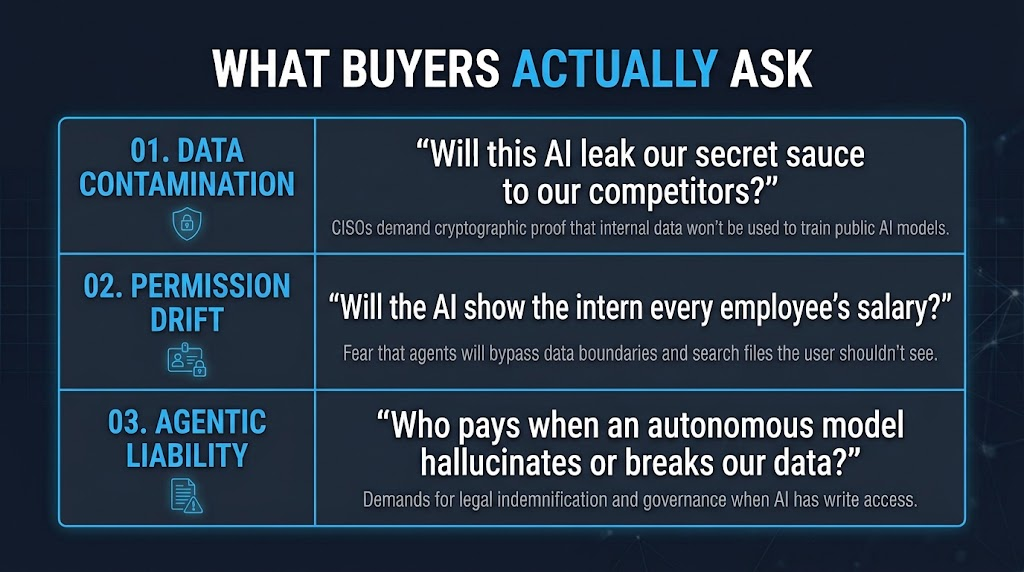
1. Data Contamination: “Will this AI leak our secret sauce to our competitors?”
- The Buyer Fear: An enterprise is terrified that if their teams feed proprietary algorithms, executive board memos, or source code into your partner-integrated AI pipeline, that data will be ingested into a shared model’s training weights—and accidentally regurgitated to a direct competitor prompting the same foundation model next month.
- The Technical Reality: CISOs demand cryptographic proof of multi-tenant isolation. They need to verify that vector embeddings, Retrieval-Augmented Generation (RAG) caches, and model telemetry are mathematically segregated and permanently excluded from training foundation models.
2. Permission Drift: “Will the AI show the intern the CEO’s salary?”
- The Buyer Fear: In any large enterprise, a junior employee cannot see HR compensation tables, and an account manager cannot view unreleased product patents. But when an AI agent indexes all company repositories to answer open-ended queries, a junior team member asking “Summarize our strategic plans” might suddenly be presented with confidential payroll spreadsheets.
- The Technical Reality: The integration cannot bypass existing Role-Based Access Controls (RBAC) or Attribute-Based Access Controls (ABAC). If the active user does not have permission to view a specific record in Salesforce, Snowflake, or AWS, the AI agent must be structurally incapable of accessing it on their behalf.
3. Agentic Liability: “Who pays when the model hallucinates or deletes core records?”
- The Buyer Fear: A conversational chatbot that hallucinates an answer is an annoyance. An autonomous AI agent with write access that hallucinates, alters contract data, or triggers an erroneous $250,000 procurement order is an existential business disaster.
- The Technical Reality: Enterprise legal and procurement teams require explicit contractual indemnification, tamper-proof immutable audit logs, and strict policy guardrails that demand human-in-the-loop approvals before any destructive or high-consequence action is committed.
The 3 Security Gates of Field-Ready AI GTM
If your field reps cannot answer those three questions in under 60 seconds without paging an engineering director, you do not have an enterprise go-to-market strategy. You have an expensive science project.
To transform AI alliances into repeatable, predictable revenue engines, your joint technical architecture must clear three non-negotiable security gates before sales reps are ever authorized to pitch:
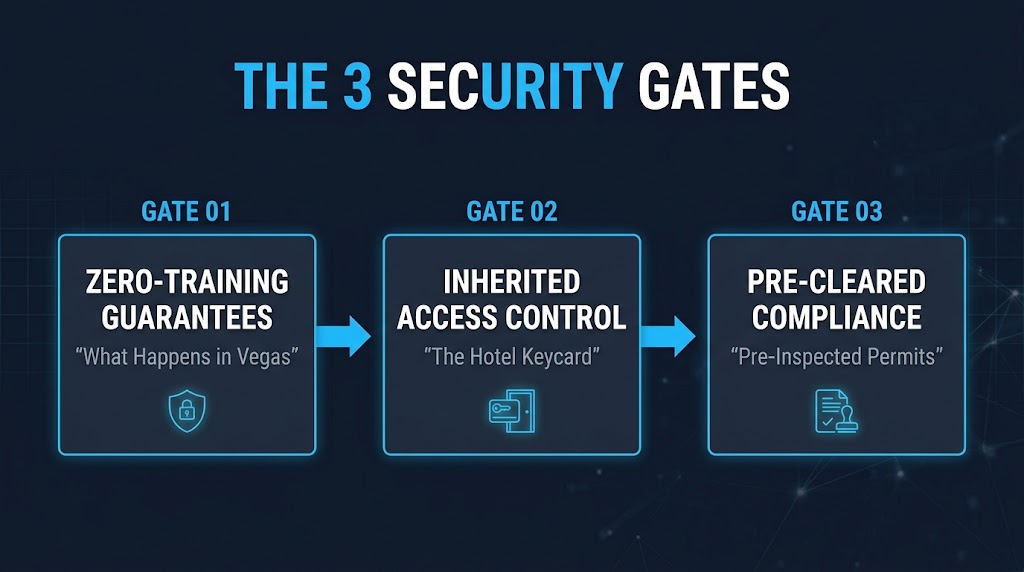
Gate 01: Zero-Training Guarantees (The “What Happens in Vegas” Rule)
- The Plain-English Concept: What happens in the customer’s tenant stays in the customer’s tenant.
- The Architecture: Deliver cryptographic tenant isolation and contractual guarantees proving that proprietary enterprise prompts, vector embeddings, and operational telemetry never leave the customer’s boundary and are never used to train or fine-tune public foundation models.
- Sales Impact: The AE can hand the CISO a one-page signed data guarantee on call one, defusing the biggest hurdle to procurement before the risk assessment begins.
Gate 02: Inherited Access Control (The “Hotel Keycard” Rule)
- The Plain-English Concept: The AI only knows what that specific person’s keycard is allowed to unlock.
- The Architecture: If a guest’s hotel keycard only opens the elevator to the 3rd floor, the AI room-service assistant cannot bypass the door and enter the penthouse on their behalf. The partner integration must enforce strict pass-through authentication and dynamic entitlement checks directly against the underlying system of record (e.g., Salesforce, ServiceNow, Snowflake, AWS IAM). If the user cannot view the file in the native app, the AI is blind to it as well.
- Sales Impact: Eliminates the CISO’s dread of having to construct, audit, and maintain a whole new permission architecture just to support your AI tool.
Gate 03: Pre-Cleared Compliance (Pre-Inspected Building Permits)
- The Plain-English Concept: Bringing pre-approved inspection certificates to the job site instead of halting construction for four months of manual audits.
- The Architecture: Arm your field teams on Day 1 with turnkey compliance binders:
- SOC 2 Type II: Proving sustained, audited operational controls around security, availability, and confidentiality.
- ISO 42001: The global gold standard for responsible, governed Artificial Intelligence Management Systems (AIMS).
- Sales Impact: Turns a grueling 4-month vendor review into a standardized compliance verification check, compressing enterprise sales cycles by 60%+.
The Field Impact: The 60-Second Whiteboard Test
In enterprise software sales, there is a simple truth:
If a sales rep cannot explain data residency, permission boundaries, and liability in under 60 seconds on a whiteboard without calling an engineer, the enterprise buyer defaults to the status quo.
When enterprise alliances treat governance as a post-sale configuration item, sales reps feel the friction immediately. They hesitate to bring partner solutions into tier-1 accounts because they know a single botched security audit can freeze their entire core renewal or expansion deal.
Enterprise buyers don’t reject AI integrations because they lack shiny features.
They reject them because the operational and reputational risk is simply too high.
The winning playbook for modern AI alliances is straightforward:
- Architect the security gates first.
- Translate complex cryptographic concepts into plain-English analogies that account executives can deliver on a discovery call.
- Equip the field with turnkey compliance packages on Day 1.
Secure the governance framework first, and the field will finally have the confidence to sell.
About the Framework
The architecture helps enterprise software companies, cloud providers, and AI platforms transition from performative logo swaps to field-aligned, revenue-producing ecosystems.
- Frameworks & Deep Dives: Read more blueprints at craigcook.ai.
- Executive Advisory: Explore enterprise ecosystem and hyperscaler advisory models at aicloudchief.com.