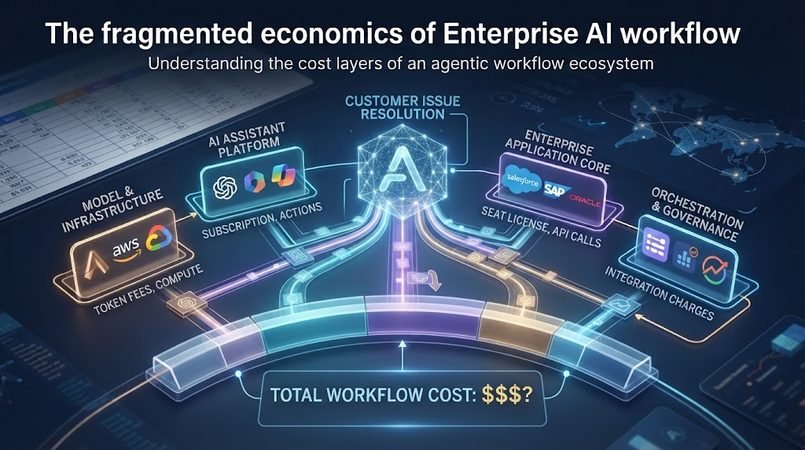
When an employee asks an AI assistant to update a deal, approve an invoice, or resolve a customer issue, who gets paid?
The assistant might come from Microsoft, Google, Anthropic, or OpenAI. The transaction may execute in Salesforce, SAP, Oracle, or Workday. Other platforms may supply the data, orchestration, and infrastructure along the way.
The work crosses platforms. The bill can, too.
For enterprise software partners, that creates both an opportunity and a threat: a new business helping customers manage AI economics, and pressure on revenue models built around selling seats.
Different vendors, different meters
Enterprise software vendors are taking different approaches to charging for AI.
Some charge by conversation or agent action. Others use consumption credits, bundle capabilities into existing subscriptions, or sell AI through per-user plans.
Model providers and infrastructure platforms introduce additional pricing structures: subscriptions, tokens, compute, and usage commitments.
These meters measure different things. A conversation might trigger several actions. An action might require multiple model calls. A completed workflow might cross several vendors.
The commercial question becomes: what does it cost to complete the work across every platform involved?
One workflow, several charges
A CFO evaluating an AI-enabled workflow may need to account for several cost layers:
- The underlying enterprise application subscription.
- The AI assistant subscription or model usage.
- Agent, integration, or orchestration charges.
- Supporting infrastructure, data access, and monitoring.
Not every workflow generates a separate charge at every layer. Some costs are bundled, some fall within existing allowances, and others increase with usage.
But the budgeting problem remains. Each vendor can explain its own bill. Someone still has to explain the total.
Consider an agent resolving a customer case. It might retrieve records, reason over the issue, request more information, update an application, and generate a response. Retries and escalations can add more activity along the way.
A low token price tells you very little about the cost of resolving that case successfully.
Customers will increasingly ask vendors—and their partners—to make that cost visible and predictable.
The interface moves. The economics are still being negotiated.
As employees start more work in AI assistants, application vendors have a strong reason to preserve their role.
Their value rests in the business processes, permissions, transaction controls, and data that make enterprise actions reliable. An assistant can initiate an invoice approval, but the finance system still determines who can approve it and how the transaction is recorded.
AI platform providers have a different advantage: they can become the place where employees start their work. That position gives them influence over which tools, models, and applications get used.
Both sides have something worth charging for. Customers will want to know whether the combined price makes sense.
Bundling AI into an existing subscription can help a vendor defend its position. Owning or selecting lower-cost models can improve margins. Charging by action can create revenue as automation grows.
My expectation is that vendors will keep experimenting with subscriptions, consumption, bundled allowances, and outcome-based pricing. Partners should expect the economics to change as quickly as the products.
Where the margin could move
I expect value to concentrate around three capabilities:
- Reasoning and orchestration: understanding the request and coordinating the work.
- Governed execution: completing actions under the customer’s business rules.
- Operational accountability: making the workflow reliable, measurable, and economical.
That third capability is where partners have an opening.
Seat-based revenue also faces pressure. If occasional users can retrieve information or initiate updates through an assistant, customers may question which application licenses they need. Whether seat counts actually fall will depend on licensing terms and access requirements.
The strategic risk is clear: partners whose economics depend heavily on seat growth need another source of value.
What partners should do
1. Build a FinOps practice for agents
Help customers forecast, allocate, and control spending across application consumption, model usage, and agent infrastructure.
Cloud FinOps grew because usage was easy to generate and difficult to predict. Agentic workflows bring a similar challenge, with more vendors involved in a single business process.
2. Measure cost per completed workflow
Track what it costs to resolve a case, approve an invoice, or qualify an opportunity from start to finish.
Include retries, exceptions, and human intervention. Measure quality and completion rates alongside cost. A workflow that runs cheaply but frequently needs correction can become expensive fast.
3. Update your own revenue model
Review how much of your business depends on seat resale, implementation projects, and ongoing administration.
Build recurring offerings around agent operations, workflow improvement, governance, and cost management. Where you can measure and influence results, consider outcome-based pricing.
As customers automate more work, partners need a commercial model that grows with the value they deliver.
4. Bring evidence to negotiations
Help customers compare equivalent workflows across vendors. Normalize bundled allowances, consumption rates, usage limits, and overage terms.
“AI included” is a starting point for analysis. Customers still need to understand what is included, how far it goes, and what happens when usage grows.
Partners who understand both the architecture and the contracts can help customers avoid expensive surprises.
The partner opportunity
When AI coordinates work across enterprise systems, the commercial relationship becomes more complicated. The assistant, the model, and the application executing the transaction may belong to different vendors.
Customers will need someone accountable for the economics of the whole workflow.
Partners who can connect architecture, contracts, and business outcomes have a valuable role to play—and a recurring service to sell.
The next growth opportunity is helping customers understand what they pay to get work done, then making that work more valuable.